Your footer is the last thing visitors see before they leave.
Make it count.
A solid collection of Tailwind footer examples saves hours of development time and gives you proven layouts that actually work across devices.
Tailwind CSS makes footer design surprisingly fast. Utility classes handle spacing, alignment, and responsive behavior without custom stylesheets.
This guide covers practical footer templates you can copy and customize. You’ll find simple one-line footers, multi-column layouts, dark mode variations, and fully accessible designs.
Each example includes working code and explains when to use it.
Let’s build better footers.
Tailwind Footer Examples
Footers get ignored until they don’t work.
Then everyone notices.
A well-built Tailwind CSS footer handles contact info, site links, legal text, and social icons without breaking your layout on mobile.
These examples show what actually works.
Tailwind footer examples
Dive into Tailwind CSS Footer

Shades of Tailwind CSS Sticky Footer

Manuela’s Responsive Masterpiece

The Underdog: Tailwind CSS Footer – Flowbite

Four Column Wonder

Prem’s Blog-tastic Footer

All About Tialwind Footer- TUK

Kometa’s Black Magic Footer

Simplicity at its Best

Reacting with Tailwind

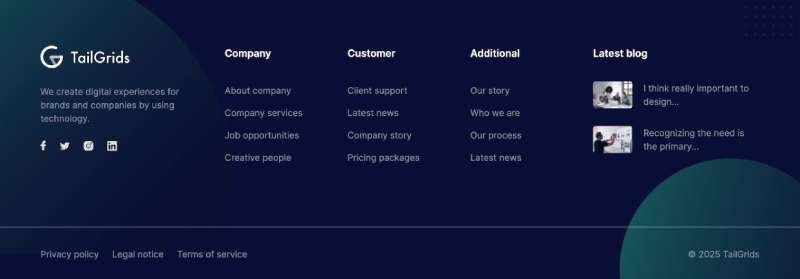
Gradient Goodness

Gopi’s Gift to Us

All-in-One Tailwind Treat

Go Big or Go Home

Nacho’s Nifty Creation

Feeling Blue?

Footer Galore
Accordion Magic in a Footer

Piet’s Clean Finish

Sophia’s Social Savvy

More than Just a Footer

Flexing with Flexbox

Why Use Tailwind CSS for Footer Design
Traditional CSS means writing custom classes for every footer variation.
Tailwind flips this approach.
You get utility-first classes that handle spacing, colors, and responsive breakpoints directly in your HTML.
Speed and Consistency
Building a multi-column footer layout takes minutes, not hours.
The utility classes stay consistent across your project, so your footer matches your navbar and content sections automatically.
Responsive Without Extra Work
Tailwind’s mobile-first approach means your footer stacks properly on phones by default.
Add md: or lg: prefixes to adjust the layout at larger screen sizes.
Comparison to Other Frameworks
If you’ve used Bootstrap footers before, Tailwind feels different.
No predefined component styles to override. You build exactly what you need. Check this comparison between Tailwind and Bootstrap for the full breakdown.
Basic Tailwind Footer Structure
Every footer starts with semantic HTML.
The <footer> tag wraps everything, then Tailwind handles the rest.
Minimal Footer Template
A simple footer needs three things: container, padding, and background color.
Something like bg-gray-900 text-white py-8 gets you started.
Essential Utility Classes
flexandjustify-betweenfor horizontal layoutsgrid grid-cols-4for multi-column sectionsgap-8for consistent spacingpx-4 lg:px-8for responsive padding
Semantic HTML Matters
Use <nav> for link groups, <address> for contact details.
Screen readers and search engines both benefit from proper web accessibility markup.
Types of Tailwind Footer Layouts
Your footer style depends on what your site actually needs.
Here’s what works for different scenarios.
Simple Footer
Copyright text, maybe a few links. Perfect for portfolios, landing pages, and minimal sites.
Uses single-row flexbox layout with justify-center or justify-between.
Multi-Column Footer
The standard for business sites. Three to four columns using Tailwind’s grid system.
Typically includes: company info, product links, resources, and contact section.
Mega Footer
Large sites with lots of navigation options need mega footers.
Five or more columns, sometimes with nested sections and newsletter signup forms.
Sticky Footer
Stays at viewport bottom even when content is short.
Achieved with min-h-screen on the body and mt-auto on the footer element.
Dark Mode Footer
Uses Tailwind’s dark: variant for automatic theme switching.
Pair bg-white dark:bg-gray-900 with text-gray-900 dark:text-white.
Key Components of Effective Tailwind Footers
Most footers share the same building blocks.
The difference is how you arrange them.
Logo and Branding
Place your logo in the first column or centered at top.
SVG logos scale cleanly across all screen sizes.
Navigation Links
Group related links under clear headings.
Use space-y-2 for vertical spacing, hover:text-blue-400 for interaction feedback.
Social Media Icons
Icon libraries like Heroicons work well with Tailwind.
Keep icons consistent in size, typically w-6 h-6 or w-5 h-5.
Contact Information
Email, phone, address in a dedicated section.
The <address> tag with not-italic class keeps formatting clean.
Newsletter Signup
A Tailwind form component in your footer captures leads.
Simple email input with a styled button works best.
Legal and Copyright
Bottom section for copyright notice, privacy policy, terms of service links.
Usually separated with a border-top and smaller text size using text-sm text-gray-500.
Responsive Tailwind Footer Design
Footers break on mobile more than any other section.
Tailwind’s responsive design utilities prevent this.
Mobile-First Approach
Start with a stacked, single-column layout. Add md:grid-cols-2 and lg:grid-cols-4 for larger screens.
Breakpoint Strategy
Tailwind’s default breakpoints work well for footers: sm:640px, md:768px, lg:1024px, xl:1280px.
Most footers need only md: and lg: prefixes.
Testing Across Devices
Check your footer at every breakpoint. The viewport width matters more than device type.
Code Examples and Templates
Working code beats theory.
Here are copy-paste templates for common footer patterns.
Simple Centered Footer
“ <footer class="bg-gray-900 text-white py-6"> <div class="container mx-auto px-4 text-center"> <p class="text-sm">© 2024 Company Name</p> </div> </footer> `
Four-Column Grid Footer
` <footer class="bg-gray-800 text-gray-300 py-12"> <div class="container mx-auto px-4 grid grid-cols-1 md:grid-cols-2 lg:grid-cols-4 gap-8"> <div> <h4 class="text-white font-bold mb-4">Company</h4> <ul class="space-y-2"> <li><a href="#" class="hover:text-white">About</a></li> <li><a href="#" class="hover:text-white">Careers</a></li> </ul> </div> <!-- Repeat for other columns --> </div> </footer> `
Footer with Newsletter Form
` <div class="flex flex-col sm:flex-row gap-2"> <input type="email" placeholder="Enter email" class="px-4 py-2 rounded bg-gray-700 text-white"> <button class="px-6 py-2 bg-blue-600 rounded hover:bg-blue-700"> Subscribe </button> </div> `
Customization and Styling Tips
Default Tailwind works fine.
But custom touches make footers memorable.
Color Schemes
Dark footers (bg-gray-900, bg-slate-800) remain popular. Light footers need stronger color contrast for readability.
Typography Choices
Footer text runs smaller than body copy, typically text-sm or text-xs.
Consider responsive typography for headings within the footer.
Spacing and Alignment
Generous padding prevents cramped footers. Use py-12 or py-16 for breathing room, gap-8 between columns.
Hover Effects and Transitions
Add transition-colors duration-200 to links. Subtle hover effects signal clickability without distraction.
Accessibility Best Practices
Footer accessibility gets overlooked constantly.
Screen reader users navigate footers frequently.
Semantic Structure
Wrap navigation groups in

Many of his resources are available on various design marketplaces. Over the years, he's worked with a range of clients and contributed to design publications like Designmodo, WebDesignerDepot, and Speckyboy, Slider Revolution among others.
- What is Backend in Web Development? - September 13, 2026
- What is Frontend Development? - September 11, 2026
- How to Make a Button in Figma: Design Best Practices - September 10, 2026

