Building an admin panel from scratch takes weeks. A good Tailwind dashboard template cuts that to hours.
The utility-first CSS framework has become the go-to choice for developers building data-rich backends and control panels. But with dozens of free and premium options available, picking the right one gets tricky.
This guide breaks down the best Tailwind dashboard examples for 2026.
You’ll find open-source templates from GitHub, premium options with extended components, and practical advice on installation, customization, and deployment. Whether you need a React dashboard template or a Vue.js admin panel, there’s something here for your stack.
What is a Tailwind Dashboard
Tailwind dashboard is a pre-built admin interface template constructed with Tailwind CSS utility classes.
It provides ready-to-use UI components for building web application backends, control panels, and data visualization interfaces without writing custom CSS from scratch.
The utility-first CSS framework approach lets you customize every element directly in your HTML.
No switching between files. No specificity conflicts.
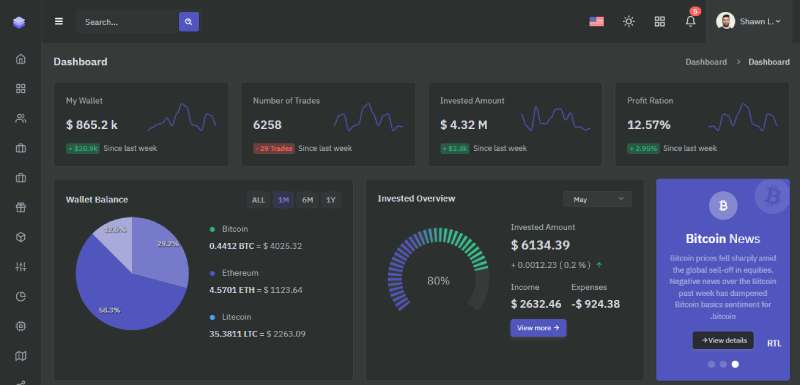
Most developers grab these templates to skip tedious setup. You get a complete dashboard UI kit with sidebar navigation, data tables, and chart widgets immediately.
What Components Does a Tailwind Dashboard Include
Standard templates ship with sidebars, data tables, chart widgets, form elements, cards, modals, notification systems, and authentication pages.
Premium versions add calendar components, kanban boards, and CRUD page templates.
What Are the Main Use Cases for Tailwind Dashboards
Admin panels and analytics platforms top the list.
E-commerce backends need order tracking and inventory views. CRM systems require contact management. SaaS applications demand user interface dashboards for billing and user management.
Tailwind dashboard examples
Argon Dashboard Tailwind

Cleopatra

Midone TailwindCSS

T-Wind

Windmill Dashboard HTML

TailAdmin – Free Tailwind CSS Dashboard Admin Template

Aatrox

Notus Angular

Mosaic Lite

Admin Template Night

D-board

Synto – Tailwind CSS Admin Dashboard Template

Soft UI Tailwind

Material Tailwind Dashboard React

Stor

Dashboard – Tailwind CSS Admin Dashboard Template

Minia – Tailwind CSS Admin & Dashboard Template
How to Choose a Tailwind Dashboard Template
Match the template to your tech stack first.
A React dashboard template won’t help if you’re building with Vue.js or Angular. TailAdmin offers versions for multiple frameworks. Mosaic Lite focuses specifically on React with Vite.
Check the GitHub repository before downloading. Recent commits signal active maintenance.
What Criteria Define a Quality Tailwind Dashboard
Component quality beats component count. Fifty well-documented components outperform two hundred poorly built ones.
Evaluate these factors:
- Framework compatibility with React, Vue, Next.js, or Laravel
- Documentation with code examples and customization guides
- Responsive design across all viewport sizes
- Dark mode support out of the box
- Performance metrics and load time
- Update frequency and issue response time
Test the live demo on mobile before committing to any template.
What Framework Options Exist for Tailwind Dashboards
Pick your stack:
- HTML/Alpine.js for lightweight projects without build tools
- React and Next.js for component-based frontend applications
- Vue.js and Nuxt.js for reactive dashboards
- Angular for enterprise-scale admin panels
- Svelte for performance-focused builds
- Laravel Blade for PHP backends
Best Free Tailwind Dashboard Examples
Free templates handle most dashboard projects. Open-source options from GitHub provide production-ready components with MIT licensing.
TailAdmin
TailAdmin delivers 200+ dashboard UI components across HTML, React, Vue, and Next.js versions.
Seven dashboard variations cover analytics, e-commerce, marketing, and CRM layouts. 4,500+ GitHub stars. Regular updates with Tailwind v4 support.
Ships with dropdown menus, tab components, and authentication pages.
Mosaic Lite
Cruip built this React dashboard template with Vite and Chart.js 3 integration.
Pre-coded chart widgets display line graphs, bar charts, and doughnut visualizations. Clean design suits SaaS products and modern web apps.
Figma design files available for customization.
Windmill Dashboard
Alpine.js integration keeps this template lightweight. Dark mode toggles instantly.
Accessibility features include proper ARIA labels and keyboard navigation support. Works well with React or Vue if you swap out Alpine.
Notus Templates
Creative Tim offers Notus in four flavors: React, Vue, Svelte, and Angular.
Each version packs 100+ components with identical designs. Five-star reviews and 1,500+ downloads. Consistent user experience across framework choices.
Flowbite Dashboard
Flowbite combines its component library with complete admin pages.
CRUD templates, kanban boards, and mailing system layouts come pre-built. 50+ example pages with interactive elements and real-time data handling.
Best Premium Tailwind Dashboard Templates
What Features Separate Premium from Free Dashboards
Premium templates add extended component libraries, priority support, XD or Figma design files, multiple color themes, and advanced integrations.
Expect 300-500 components versus 100-150 in free versions.
TailAdmin Pro
Pricing tiers start at $49 for single projects. Unlimited license runs $149.
500+ components including AI dashboard pages, logistics tracking, and customer support interfaces. Seven unique dashboard variations with dedicated support channels.
Soft UI Dashboard Tailwind
Material Design aesthetics meet Tailwind utility classes.
Soft gradients and rounded corners define the visual style. 40+ React components with detailed documentation. Good fit for projects needing a polished, professional look.
How to Install a Tailwind Dashboard Template
What Are the Prerequisites for Tailwind Dashboard Setup
Node.js 16+ and npm (or yarn) handle dependencies.
Tailwind CSS v3 or v4 depending on template version. Framework-specific requirements: React 18+, Vue 3+, or Next.js 13+ for those stacks.
What Steps Complete a Basic Tailwind Dashboard Installation
Clone the GitHub repository, install dependencies, start the dev server:
git clone [repository-url]cd [project-folder]npm installnpm run dev
Build for production with npm run build. Output lands in the dist folder.
How to Customize a Tailwind Dashboard
What Configuration Files Control Dashboard Appearance
The tailwind.config.js file controls everything: color palette, fonts, spacing scale, and breakpoints.
Extend the default theme or override it completely. Add custom colors with hex values or CSS variables for theme switching.
How to Add New Components to an Existing Dashboard
Follow the template’s component file structure. Import patterns vary by framework.
Match existing styling by reusing utility class patterns. Test across responsive breakpoints before deploying.
How to Integrate Charts and Data Visualization
Chart.js works out of the box with most templates. ApexCharts provides more customization.
Recharts suits React projects. Bind data through props or state management. JavaScript handles real-time updates via API calls.
What Performance Considerations Apply to Tailwind Dashboards
How to Optimize Tailwind Dashboard Load Time
PurgeCSS removes unused styles automatically in production builds.
Code splitting loads components on demand. Lazy load heavy chart libraries. Optimize images with SVG icons instead of PNGs where possible.
What Lighthouse Scores Should a Tailwind Dashboard Achieve
Target 90+ for Performance, Accessibility, and Best Practices.
SEO scores matter less for authenticated admin panels. Core Web Vitals: LCP under 2.5s, FID under 100ms, CLS under 0.1.
How to Make a Tailwind Dashboard Accessible
Add ARIA labels to all interactive buttons and form inputs.
Support keyboard navigation through logical tab order. Maintain color contrast ratios of 4.5:1 minimum for text. Test with screen readers like NVDA or VoiceOver.
Use the accessibility checklist during development.
How to Deploy a Tailwind Dashboard Application
Vercel handles Next.js deployments with zero configuration. Connect your GitHub repo and push.
Netlify works well for static builds and Vue/React SPAs. Docker containerization suits complex server requirements.
Basic server needs: Node.js runtime for SSR, static file hosting for SPAs.
FAQ on Tailwind Dashboard Examples
What is the best free Tailwind dashboard template?
TailAdmin leads the free options with 200+ components, seven dashboard variations, and support for React, Vue, and Next.js. Active GitHub maintenance and Tailwind v4 compatibility make it reliable for production projects.
Can I use Tailwind dashboards with React?
Yes. Most popular templates offer dedicated React versions. Mosaic Lite uses Vite with React 18. TailAdmin and Notus provide React-specific builds with pre-configured component structures and hooks.
Are Tailwind dashboard templates mobile responsive?
Quality templates include mobile-first design patterns. Sidebar navigation collapses into hamburger menus. Tables become scrollable. Test any template on actual devices before committing.
How do I add charts to a Tailwind dashboard?
Most templates integrate Chart.js or ApexCharts. Import the library, create a canvas element, and bind your data. Progress bars and simple visualizations work with pure CSS utility classes.
What is the difference between TailAdmin free and pro versions?
Free TailAdmin includes 200+ components. Pro expands to 500+ with AI dashboard pages, logistics tracking, customer support interfaces, and priority support. Pro licensing starts at $49 for single projects.
Do Tailwind dashboards support dark mode?
Most modern templates include dark mode. Tailwind’s built-in dark variant classes handle the switching. Configure darkMode: 'class' in tailwind.config.js to toggle themes with toggle switches.
Can I customize the color scheme of a Tailwind dashboard?
Absolutely. Edit the tailwind.config.js file to override default colors. Add custom hex values or CSS variables. Changes apply globally across all components using those color utilities.
Which Tailwind dashboard works best for e-commerce backends?
TailAdmin’s e-commerce variation includes product listings, order management, and invoice templates. Flowbite Dashboard offers CRUD pages for inventory. Both provide pagination components for large product catalogs.
How do I deploy a Tailwind dashboard application?
Vercel handles Next.js deployments automatically. Netlify works for static builds. Run npm run build to generate production files, then upload to your hosting provider or connect your Git repository.
Are Tailwind dashboard templates accessible?
Quality varies. Windmill Dashboard prioritizes accessible form elements and keyboard support. Always audit templates with Lighthouse. Add proper labels and focus states where missing.
Conclusion
The right Tailwind dashboard examples accelerate your admin panel development from weeks to days.
Free options like TailAdmin, Mosaic Lite, and Windmill Dashboard deliver production-ready components with MIT licensing. Premium templates add extended UI libraries and dedicated support when projects demand more.
Focus on framework compatibility first. A Next.js or Angular build needs matching template versions.
Check GitHub activity before downloading. Recent commits signal active maintenance and Tailwind v4 support.
Customize through tailwind.config.js for hero sections, color themes, and alert components. Test dashboard performance with Lighthouse. Add accessible typography and proper focus states.
Start with a free template. Scale to premium when your SaaS dashboard or CRM project requires advanced features.

Many of his resources are available on various design marketplaces. Over the years, he's worked with a range of clients and contributed to design publications like Designmodo, WebDesignerDepot, and Speckyboy, Slider Revolution among others.
- What is Backend in Web Development? - September 13, 2026
- What is Frontend Development? - September 11, 2026
- How to Make a Button in Figma: Design Best Practices - September 10, 2026