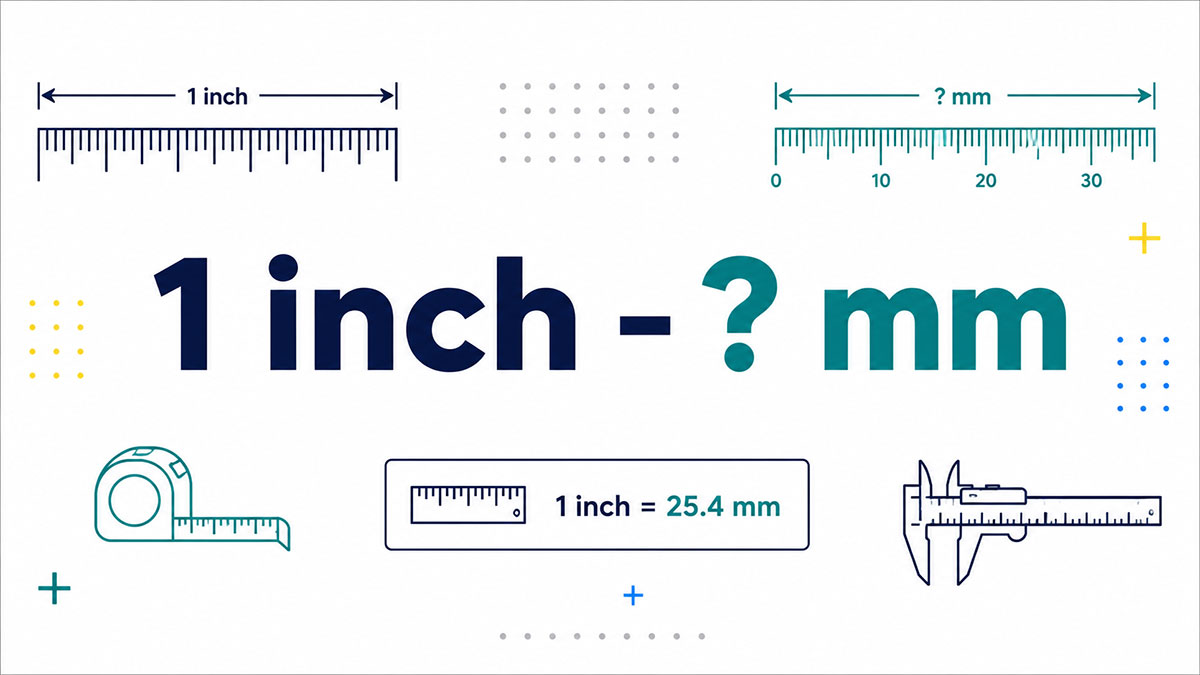
You measure something in inches, then the spec sheet in front of you is written in millimeters. Now what?
The short answer: one inch is 25.4 millimeters, exactly. That single number handles nearly every conversion you will ever need.
Knowing how many mm in an inch matters far past trivia. Drill bits, screen sizes, print layouts, and machine drawings all cross between the imperial and metric systems.
This guide covers the parts that actually come up:
- The exact conversion factor and how to run it both directions
- Whole, decimal, and fractional inch values in millimeters
- Why 1959 fixed the inch, plus the one survey-inch exception
By the end, the math and the reasoning behind it will both make sense.
What Is an Inch in Millimeters?
One inch equals 25.4 millimeters, exactly. Not rounded, not approximate. This value is fixed by international agreement, so it holds everywhere the metric and imperial systems meet.
The reverse works too: one millimeter equals 0.03937 inches.
The inch sits in the imperial and US customary systems. The millimeter is a metric unit, one thousandth of a meter in the SI system.
“Exact” matters here. The 25.4 figure is a defined conversion factor, not something measured with a ruler and then rounded off.
How Do You Convert Inches to Millimeters?
Multiply the inch value by 25.4. That single step gives millimeters, and because 25.4 is exact, whole-number inches convert with zero precision loss.
Millimeters = inches x 25.4
- 2 in = 50.8 mm
- 6 in = 152.4 mm
- 12 in = 304.8 mm (one foot)
Every result above is exact. CAD software and machine drawings run the same multiply-by-25.4 step in the background.
How Do You Convert Millimeters to Inches?
Divide the millimeter value by 25.4. The answer is inches, though most conversions land on a repeating decimal instead of a clean number.
Inches = millimeters / 25.4
100 mm: 3.937 inches
50 mm: 1.9685 inches
10 mm: 0.3937 inches
Why the messy decimals? Dividing by 25.4 rarely terminates, so mm-to-inch results run on. For engineering work, round to four decimal places and you are safe.
Inch to Millimeter Conversion Table
Common inch values map to fixed millimeter equivalents. Keep this nearby and skip the math.
| Inches | Millimeters |
|---|---|
| 1 | 25.4 |
| 2 | 50.8 |
| 3 | 76.2 |
| 6 | 152.4 |
| 12 | 304.8 |
Decimal inches convert the same way: 0.5 in = 12.7 mm, 0.25 in = 6.35 mm, 0.125 in = 3.175 mm.
Going the other direction, here are the round millimeter values people look up most:
| Millimeters | Inches |
|---|---|
| 5 | 0.19685 |
| 10 | 0.3937 |
| 25 | 0.98425 |
| 50 | 1.9685 |
| 100 | 3.937 |
Whole-inch rows are exact. The mm-to-inch column is rounded to five decimals, since those values never terminate.
How Do You Convert Fractional Inches to Millimeters?
Turn the fraction into a decimal, then multiply by 25.4. A quarter inch becomes 0.25, times 25.4, so 6.35 mm. Same two steps for any mark on a tape measure.
This comes up constantly with hardware. Sockets, drill bits, and US tape measures are marked in halves, quarters, eighths, and finer.
Halves, Quarters, and Eighths in Millimeters
The everyday fractions:
| Fraction | Millimeters |
|---|---|
| 1/2 in | 12.7 |
| 1/4 in | 6.35 |
| 1/8 in | 3.175 |
Sixteenths, Thirty-Seconds, and Sixty-Fourths in Millimeters
Finer graduations show up on precision rulers and machinist scales.
- 1/16 in = 1.5875 mm
- 1/32 in = 0.79375 mm
- 1/64 in = 0.396875 mm
The decimals get long fast, which is exactly why machinists working to tight tolerances tend to switch to millimeters and stay there.
Why Is One Inch Defined as Exactly 25.4 Millimeters?
The 1959 International Yard and Pound Agreement set it. Six English-speaking nations signed on July 1, 1959, fixing the yard at 0.9144 meters, which makes the inch exactly 25.4 mm.
The six signatories: the United States, the United Kingdom, Canada, Australia, New Zealand, and South Africa.
Before 1959, the inch drifted between countries. The old US inch measured 25.4000508 mm and the UK inch about 25.399977 mm, a gap of roughly 2 parts per million (per the National Bureau of Standards, Refinement of Values for the Yard and the Pound, 1959).
The agreement tied the inch to the meter through the SI system. One global value, no more national variants for engineering and trade.
What Is the Difference Between the International Inch and the US Survey Inch?
The US survey inch runs very slightly longer than 25.4 mm. It came from the older survey foot (1200/3937 meter), and the gap sits at about 2 parts per million, which only shows up across long distances.
| Version | Basis | Status |
|---|---|---|
| International inch | 25.4 mm (exact) | Current standard |
| US survey inch | Based on the US survey foot (1200/3937 m) | Deprecated (2022) |
The retirement date: NIST, the National Geodetic Survey, and NOAA deprecated the US survey foot on December 31, 2022. From January 1, 2023, the international foot is the single legal foot.
How big is the gap in practice? About one-eighth of an inch per mile (Esri, 2023). Real for surveyors, invisible for everyone else.
For every everyday and engineering use, 25.4 mm is the number you want.
Where Is the Inch to Millimeter Conversion Used?
The inch to millimeter conversion shows up wherever imperial and metric systems overlap. Manufacturing, displays, construction, and print all mix the two.
The United States, Liberia, and Myanmar are the only countries without full official metric adoption (Statista), so US work crosses both systems every day.
| Field | Measured in Inches | Measured in Millimeters |
|---|---|---|
| Manufacturing | Tolerances, fasteners | Machine specifications, tooling |
| Displays | Screen diagonal | Panel dimensions |
| Construction | Lumber, pipe | Metric fasteners |
| Page size | Bleed, margins |
Manufacturing and Machining
Factory drawings routinely carry dual dimensions, inches on one line and millimeters below. Tolerances get specified in both so parts sourced from different countries still fit.
Aerospace splits down the middle. Boeing designs largely in inches, Airbus works in millimeters, and suppliers convert constantly to serve both.
Screen and Display Sizes
Screens are sold by the diagonal, in inches. Panel engineering, bezels, and mounting holes get spelled out in millimeters.
A 27-inch monitor measures 685.8 mm corner to corner. The resolution on top of that physical size determines how many pixels sit in each inch.
Construction and DIY
Job sites mix systems part by part. Common crossovers:
- Lumber sized in inches, hardware in metric threads
- Pipe diameters quoted both ways
- Sheet goods labeled in fractions, stocked in mm
Nominal 1/4 inch plywood works out to 6.35 mm, which is why metric shelves often sell it as a 6 mm sheet.
Print and Design
Layout tools bounce between inch page sizes and millimeter production specs. US Letter runs 8.5 by 11 inches; A4 is 210 by 297 mm.
Bleed margins: a standard 1/8 inch bleed converts to 3.175 mm, the value most European print shops expect.
Print resolution is measured in dots per inch, and the 300 DPI print standard ties image detail directly back to that inch measurement.
FAQ on How Many Mm In An Inch
How many mm in an inch?
One inch equals 25.4 millimeters, exactly. This is a defined value, not a rounded one, fixed by international agreement in 1959. The same figure applies in every country that uses both the metric and imperial systems.
How do you convert inches to millimeters?
Multiply the inch value by 25.4. So 2 inches becomes 50.8 mm, and 12 inches (one foot) becomes 304.8 mm. Because 25.4 is exact, whole-number inches convert with no precision loss.
How do you convert millimeters to inches?
Divide the millimeter value by 25.4. For example, 100 mm equals 3.937 inches. Most mm-to-inch results are non-terminating decimals, so round to four places for engineering work.
How many mm is half an inch?
Half an inch is 12.7 millimeters. The math is simple: 0.5 times 25.4 equals 12.7. A quarter inch is 6.35 mm, and one-eighth inch is 3.175 mm.
Is one inch exactly 25.4 mm?
Yes. The 1959 International Yard and Pound Agreement set the inch at exactly 25.4 mm. It is a legally defined conversion factor, so there is no rounding error in the ratio itself.
How many mm are in 1/16 of an inch?
One-sixteenth of an inch is 1.5875 mm. Finer marks follow the pattern: 1/32 inch is 0.79375 mm and 1/64 inch is 0.396875 mm. These show up on precision rulers.
How many mm in 2 inches?
Two inches equal 50.8 mm. Multiply 2 by 25.4 and you get the exact figure. Common uses include pipe diameters, larger fasteners, and hardware sizing across both measurement systems.
Why was the inch defined as 25.4 mm?
Six nations signed the 1959 agreement to end tiny national differences in the inch. Fixing the yard at 0.9144 meters made the inch exactly 25.4 mm, giving one shared global value.
Is the US survey inch different from 25.4 mm?
Slightly. The US survey inch, based on the old survey foot, ran about 2 parts per million longer. NIST deprecated the survey foot on December 31, 2022, leaving 25.4 mm as standard.
How many mm in an inch on a ruler?
Each inch on a ruler spans 25.4 mm. So a 12-inch ruler measures 304.8 mm end to end. The millimeter marks between inches let you read finer metric measurements directly.
Conclusion
Now you know how many mm in an inch, and the reasoning that locks the number in place. One inch is 25.4 millimeters, and that value never shifts.
Keep two operations in mind. Multiply by 25.4 to reach millimeters, divide by 25.4 to get back to inches.
Whole numbers, decimals, and fractions all run through the same conversion factor. A tape measure marked in sixteenths and a metric drawing describe the same distance.
The 1959 International Yard and Pound Agreement gave the world one shared inch. The lone exception, the retired US survey inch, no longer affects daily work.
Bookmark the table, trust the 25.4 ratio, and any inch-to-millimeter measurement becomes a five-second calculation instead of a guess.

Many of his resources are available on various design marketplaces. Over the years, he's worked with a range of clients and contributed to design publications like Designmodo, WebDesignerDepot, and Speckyboy, Slider Revolution among others.
- What is Backend in Web Development? - September 13, 2026
- What is Frontend Development? - September 11, 2026
- How to Make a Button in Figma: Design Best Practices - September 10, 2026

